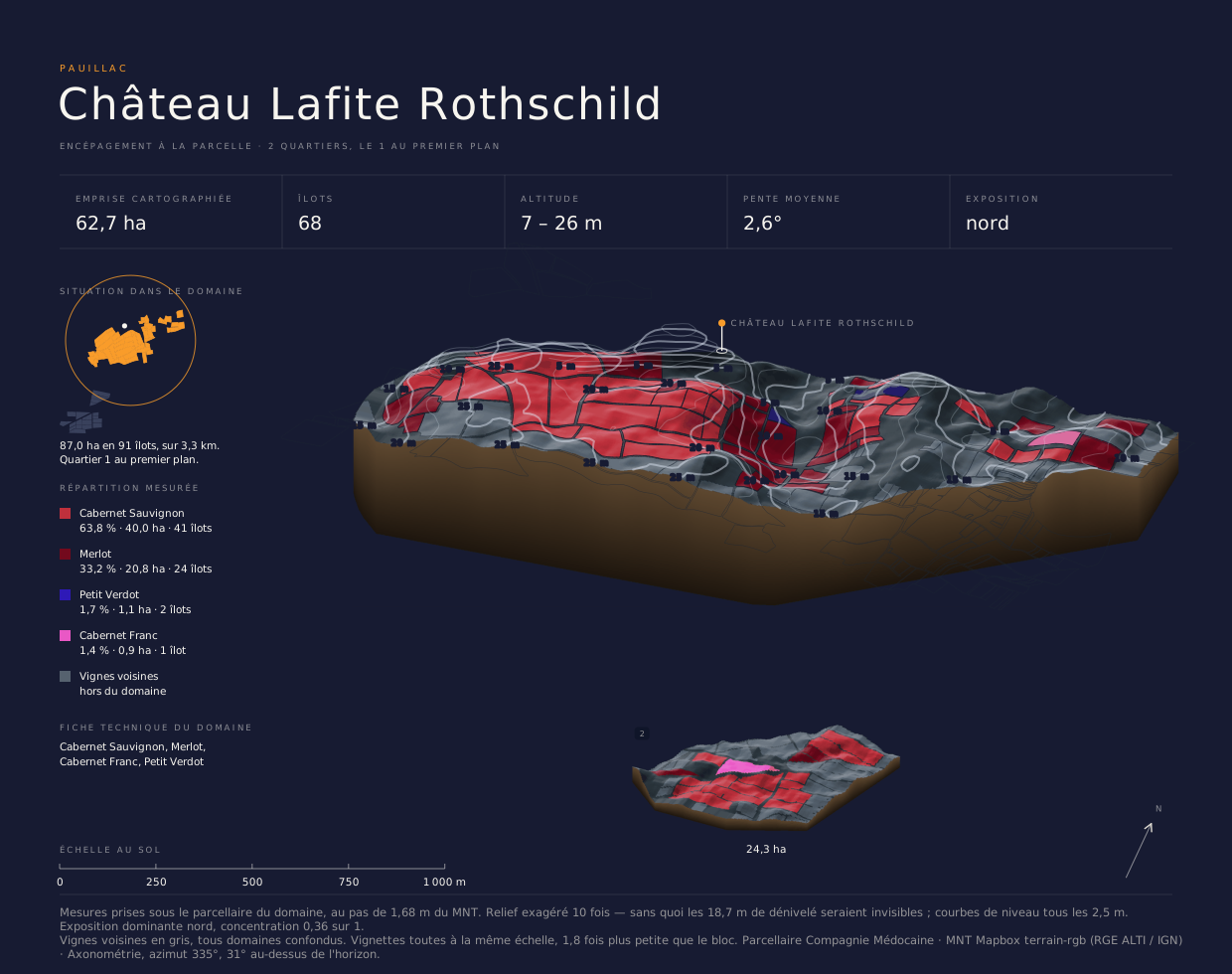
Area under vine at the estate, from its technical sheet — it does not change from one vintage to the next. Each vintage’s blend, by contrast, departs from it: that figures on its own page. The estate does not publish the share of each grape variety: they are listed without proportions.
In the 3D view: drag to rotate, scroll to zoom, Shift+drag to pan, double-click to reset.
Footprint, parcels and their split are measured on the Compagnie Médocaine’s own parcel survey; elevation, slope and aspect on the Mapbox terrain-rgb digital terrain model, derived from IGN’s RGE ALTI over France. Compare with the blend on the technical sheet, at the top of the page: the two answer different questions.
Why buy it
Premier Grand Cru Classé in 1855Abraham Lawton had already ranked it at the top in 1815: 'the greatest elegance and delicacy, and the finest character, of the three.'
One hundred and twelve hectares of fine gravelThe château's hillsides, the Carruades plateau, and a plot in Saint-Estèphe; the oldest, La Gravière, planted in 1886.
100/100 from James Suckling in 2025Twenty-five vintages at 95 or above since 1982, with a floor of 97 since 2009.
The grand vin uses only the old vinesThe twenty hectares under ten years old are excluded: the grand vin's average vine age approaches 45 years.
The wine
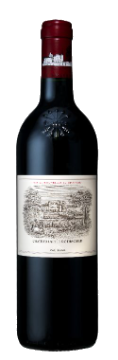
The grand vin of Château Lafite Rothschild needs no introduction. As early as 1815, Abraham Lawton already ranked it at the very top: « I have classed it as possessing the greatest elegance and delicacy and the finest sap of the three [premiers crus] », a ranking confirmed in 1855.
Terroir
The vineyard comprises three main areas: the slopes around the Château, the Carruades plateau adjoining it to the west, and a 4.5 ha parcel in the neighbouring commune of Saint Estèphe. The vineyard covers 112 ha of fine, deep gravel soils mixed with aeolian sands over a Tertiary limestone subsoil, well drained and well exposed. The grape varieties are Cabernet Sauvignon (70%), Merlot (25%), Cabernet Franc (3%) and Petit Verdot (2%). The average age of the vines is 38 years overall, but it should be noted that vines under 10 years old (20 ha) do not go into the grand vin, so that the average age of the vines contributing to the grand vin is closer to 45 years. The oldest parcel, known as « La Gravière », was planted in 1886.
Drought without any halt in ripening, together with cool nights, gave a legendary vintage: concentrated, with firm tannins and very long aging potential.
“Best score”: the highest score recorded for this wine, with its source. “Character”: the overall reading of the year across the appellation, which an estate may depart from.
The texts below copy in one click for your product sheets, catalogues and social channels. The printable sheet condenses the whole page onto a single A4 page.
For this vintage, the media library contains: packshots, labels. High-definition packshots, labels, back labels and lifestyle photos are reserved for clients and partners, on the Compagnie Médocaine’s VinCod media library.
Sheet checked on September 21, 2026. Technical data: the estate’s VinCod sheets. Critic scores: sources cited above, with their date. Vintage benchmarks and character: Compagnie Médocaine’s own editorial read. Soils and relief, where shown: the Compagnie Médocaine’s parcel survey and the Mapbox/IGN terrain model.


 Château Haut-Batailley
 Château Grand-Puy-Lacoste
 Château Pédesclaux
 Château Pibran
 Château Pichon Baron
 Les Tourelles de Pichon Baron
 Château Pichon Comtesse
 Château Lynch-Bages
 Château Mouton Rothschild
 Château Duhart-Milon
 Château Clerc Milon
 Château d'Armailhac
 Château Pontet-Canet