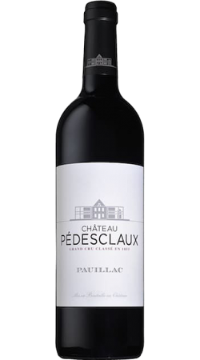
Pauillac · vintage 2015
 Grands crus atlas
Vintage benchmark: 93/100 (appellation benchmark, not a score for this wine)
Vintage character: A hot summer tempered by August rains gave expansive wines, with rounded tannins and generous fruit.
Overall reading of the year’s season across Pauillac. An estate can depart from it sharply, in frost or hail years, where two neighbours did not make the same vintage. What this particular wine actually gave is on its technical sheet and in the scores above.
Intense deep garnet color. The nose quickly reveals great complexity with aromas of blackcurrant, orange peel and spices, brought by the Petit verdot present in the Château Pédesclaux blend for the first time. Aeration allows you to appreciate the full breadth of this aromatic palette marked by licorice, cinnamon and cardamom. We find a very nice volume on the palate, with notes of gingerbread and blond tobacco, characteristic of the great Pauillac terroirs. The texture of the tannins, suave and silky, shows a very beautiful harmony between power, elegance and subtlety.
Shares for this vintage, as recorded on the 2015 technical sheet. The vineyard itself is planted with cabernet sauvignon, merlot, cabernet franc, petit verdot — a vintage blend departs from the area under vine as the year dictates.
For the second year, we are using our 100% gravity vat in the interest of total respect for the grapes and the wine! Thus, the harvest collected in small crates is cooled in a cold room for 24 hours then transported by elevator to the sorting tables. After selection, the uncrushed berries are delicately placed in rolling vats, which transport them like caviar into truncated conical vats adapted to the size of each plot. Following pre-fermentation maceration, allowing the aromas and color to diffuse gently, fermentation can take place with temperatures favoring slow extraction and intense expression of fruit. A long vatting follows, allowing everything to harmonize. The wine will then be poured by gravity into new barrels (50%) and one-wine barrels (50%), produced with long-heated barrels.
Beneath the vines of Pédesclaux lies a geological masterpiece whose origins date back 40 million years. It is this unique terroir, quintessentially Médoc, that the 1855 classification recognises. The château stands on a plateau of gravel overlooking the town of Pauillac; the soil is made up of clay-limestone gravels, in reality a mixture of clay, limestone, fine gravel and pebbles. These plots in fact adjoin renowned properties such as Mouton-Rothschild and Pontet-Canet. Pédesclaux works with three different grape varieties: 47% Cabernet Sauvignon for the structure of the wine, 48% Merlot for roundness, and 2% Cabernet Franc and 3% Petit Verdot for aromatic complexity.
Availability, allocations and terms: the Compagnie Médocaine will reply promptly. The estate and vintage are already filled in in the message.
The texts below copy in one click for your product sheets, catalogues and social channels. The printable sheet condenses the whole page onto a single A4 page.
For this vintage, the media library contains: packshots, labels. High-definition packshots, labels, back labels and lifestyle photos are reserved for clients and partners, on the Compagnie Médocaine’s VinCod media library.
Sheet checked on September 21, 2026. Technical data: the estate’s VinCod sheets. Critic scores: sources cited above, with their date. Vintage benchmarks and character: Compagnie Médocaine’s own editorial read. Soils and relief, where shown: the Compagnie Médocaine’s parcel survey and the Mapbox/IGN terrain model.