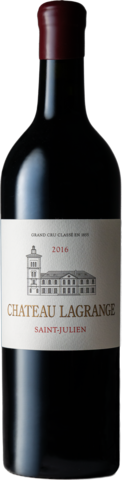
Saint-Julien · vintage 2016
Château Lagrange 2016
Ageing potential20 years and beyond
 Grands crus atlas
Ageing potential20 years and beyond
Vintage benchmark: 97/100 (appellation benchmark, not a score for this wine)
Vintage character: A very wet winter followed by a sun-drenched summer produced a rare balance, combining the depth of great years with genuine freshness.
Overall reading of the year’s season across Saint-Julien. An estate can depart from it sharply, in frost or hail years, where two neighbours did not make the same vintage. What this particular wine actually gave is on its technical sheet and in the scores above.
Deep black with purple highlights. Notes of black cherry, blackcurrant, licorice and pepper. The attack is rich, with a full mid-palate underpinned by a mentholated freshness. A great deal of roundness, power and length offering immediate pleasure. This 2016 is unquestionably an exceptional vintage built for long cellaring, with silky, racy tannins. An unrivalled harmony to date for this great wine, both classic and modern. (2021-2045)
Shares for this vintage, as recorded on the 2016 technical sheet. The vineyard itself is planted with 67 % cabernet sauvignon, 28 % merlot, 5 % petit verdot — a vintage blend departs from the area under vine as the year dictates.
- Parcel and intra-parcel selection combined with the 102 variable-capacity stainless steel vats (36-220 hl) - Traditional Bordeaux vinification at 26-28°C - Moderate daily pump-over, or rack-and-return, or punching down - Maceration time of 18 to 25 days - Selection of free-run and press wine - Malolactic fermentation by co-inoculation - Blending of lots and differentiation between the Grand Vin (Château Lagrange) and the second wine (Les Fiefs de Lagrange) in the February following the harvest. - 12% press wine in Château Lagrange. - 49% Château Lagrange and 51% Fiefs de Lagrange. - Average age of the vines that produced Château Lagrange: 42 years
- Air-conditioned cellars with controlled humidity - Ageing temperature of 15°C - 60% new barrels every year for Château Lagrange - Ageing in barrel for 21 months - Further maturation with racking every three months - Fining with fresh egg whites in barrel - Final blend before bottling
Located in the Saint-Julien appellation, the vineyard extends over two gravel rises of « Günzian » origin running north-south. Sometimes fine, sometimes coarser, these gravels are accompanied either by sand or by ferruginous clay. At an altitude of 24 metres, the centre of the estate is the highest point in Saint-Julien. Of the property's total area of 157 hectares, 118 hectares are planted to vine and most of the parcels are drained. The planting, entirely in keeping with the Médoc terroir, consists of 67% Cabernet Sauvignon, 28% Merlot and 5% Petit Verdot. Cabernet Sauvignon brings structure and ageing potential, Merlot roundness and flesh, and Petit Verdot fruit and complexity.
Availability, allocations and terms: the Compagnie Médocaine will reply promptly. The estate and vintage are already filled in in the message.
The texts below copy in one click for your product sheets, catalogues and social channels. The printable sheet condenses the whole page onto a single A4 page.
For this vintage, the media library contains: packshots, labels. High-definition packshots, labels, back labels and lifestyle photos are reserved for clients and partners, on the Compagnie Médocaine’s VinCod media library.
Sheet checked on September 21, 2026. Technical data: the estate’s VinCod sheets. Critic scores: sources cited above, with their date. Vintage benchmarks and character: Compagnie Médocaine’s own editorial read. Soils and relief, where shown: the Compagnie Médocaine’s parcel survey and the Mapbox/IGN terrain model.