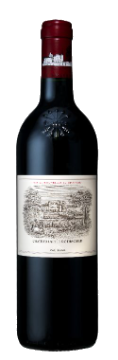
Pauillac · vintage 2000
 Grands crus atlas
Vintage benchmark: 96/100 (appellation benchmark, not a score for this wine)
Vintage character: After a wet spring, a dry summer and a perfect September gave the decade's first great vintage: dense, complete, with very long aging potential.
Overall reading of the year’s season across Pauillac. An estate can depart from it sharply, in frost or hail years, where two neighbours did not make the same vintage. What this particular wine actually gave is on its technical sheet and in the scores above.
A great among the greats. The tastings carried out at the time of the en primeur release showed sumptuous, captivating aromas, a palate that was both powerful and of great finesse, with a remarkable tannic base and length.
Shares for this vintage, as recorded on the 2000 technical sheet. The vineyard itself is planted with cabernet sauvignon, merlot, cabernet franc, petit verdot — a vintage blend departs from the area under vine as the year dictates.
The maceration duration varies depending on each tank, but is generally around 20 days. Following malolactic fermentation, the wines are barreled into French oak barrels. Lafite has its own cooperage in Pauillac, a factor which contributes to its unique style.
Following blending, the wine begins its 20-month period of ageing and maturation in new oak barrels.
The vineyard comprises three main areas: the slopes around the Château, the Carruades plateau adjoining it to the west, and a 4.5 ha parcel in the neighbouring commune of Saint Estèphe. The vineyard covers 112 ha of fine, deep gravel soils mixed with aeolian sands over a Tertiary limestone subsoil, well drained and well exposed. The grape varieties are Cabernet Sauvignon (70%), Merlot (25%), Cabernet Franc (3%) and Petit Verdot (2%). The average age of the vines is 38 years overall, but it should be noted that vines under 10 years old (20 ha) do not go into the grand vin, so that the average age of the vines contributing to the grand vin is closer to 45 years. The oldest parcel, known as « La Gravière », was planted in 1886.
Availability, allocations and terms: the Compagnie Médocaine will reply promptly. The estate and vintage are already filled in in the message.
The texts below copy in one click for your product sheets, catalogues and social channels. The printable sheet condenses the whole page onto a single A4 page.
For this vintage, the media library contains: packshots, labels. High-definition packshots, labels, back labels and lifestyle photos are reserved for clients and partners, on the Compagnie Médocaine’s VinCod media library.
Sheet checked on September 21, 2026. Technical data: the estate’s VinCod sheets. Critic scores: sources cited above, with their date. Vintage benchmarks and character: Compagnie Médocaine’s own editorial read. Soils and relief, where shown: the Compagnie Médocaine’s parcel survey and the Mapbox/IGN terrain model.