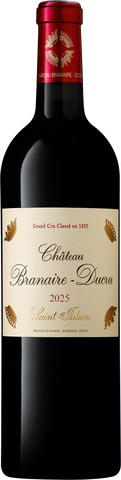
Saint-Julien · vintage 2025
 Grands crus atlas
Vintage benchmark: 94/100 (appellation benchmark, not a score for this wine)
Vintage character: A dry, bright summer, tempered by cool nights, gave pure, balanced wines, more classic than sun-drenched.
Overall reading of the year’s season across Saint-Julien. An estate can depart from it sharply, in frost or hail years, where two neighbours did not make the same vintage. What this particular wine actually gave is on its technical sheet and in the scores above.
2025 se présente comme un très grand millésime, déjà accessible à la dégustation, très expressif dans son intense complexité aromatique, son harmonie et la douceur de sa matière pourtant d’une belle densité.
Content available in French
Shares for this vintage, as recorded on the 2025 technical sheet. The vineyard itself is planted with 70 % cabernet sauvignon, 22 % merlot, 4 % petit verdot, 4 % cabernet franc — a vintage blend departs from the area under vine as the year dictates.
Remplissage des cuves entièrement par gravité avec une cuve mobile
75 cuves en acier inoxydable, thermorégulées, permettant de vinifier toutes les parcelles séparément
Température de fermentation : 25-27 °C
Durée de macération : 3-4 semaines selon le millésime
Assemblage des vins au début de l'élevage, au plus tard en février suivant la récolte
Content available in French
Elevage en fûts de chêne français pendant 16 à 20 mois, avec 60 à 65 bois neufs.
Bois fins sélectionnés dans plusieurs forêts françaises pour la qualité de leurs arômes et de leurs tanins.
Faible chauffe du bois, respectant le caractère et le fruit des vins
Soutirage traditionnel des fûts, à l'abri de l'air.
Content available in French
The Branaire-Ducru vineyard is made up of several separate parcels, but with a terroir that remains homogeneous, on a very fine gravel rise at Beychevelle. The soil consists mainly of Quaternary gravelly-siliceous alluvium lying on a bed of alios (iron hardpan). The average age of the vineyard is 35 years. The blend at Château Branaire-Ducru is 70% Cabernet Sauvignon, 22% Merlot and 4% each of Petit Verdot and Cabernet Franc. Planting density is 8,000 vines/ha, for a yield of 40 hl/ha. Harvesting is by hand, with rigorous sorting in the vineyard and on sorting tables. Viticulture is conventional.
Availability, allocations and terms: the Compagnie Médocaine will reply promptly. The estate and vintage are already filled in in the message.
The texts below copy in one click for your product sheets, catalogues and social channels. The printable sheet condenses the whole page onto a single A4 page.
For this vintage, the media library contains: packshots, lifestyle photos. High-definition packshots, labels, back labels and lifestyle photos are reserved for clients and partners, on the Compagnie Médocaine’s VinCod media library.
Sheet checked on September 21, 2026. Technical data: the estate’s VinCod sheets. Critic scores: sources cited above, with their date. Vintage benchmarks and character: Compagnie Médocaine’s own editorial read. Soils and relief, where shown: the Compagnie Médocaine’s parcel survey and the Mapbox/IGN terrain model.