
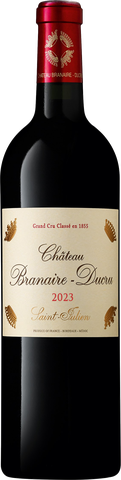
Why this vintage
- 95/100 from James Sucklingand 5 other scores above 90/100.
- The 2023 vintage in Saint-JulienJuly mildew followed by a hot September demanded strict selection: fleshy, aromatic wines, more approachable than 2022.
Critic scores
- James Suckling95
- Decanter95
- Wine Advocate94
- Jeb Dunnuck94
- Wine Spectator94
- Vinous93
The 2023 vintage in Saint-Julien
Vintage benchmark: 91/100 (appellation benchmark, not a score for this wine)
Vintage character: July mildew followed by a hot September demanded strict selection: fleshy, aromatic wines, more approachable than 2022.
Overall reading of the year’s season across Saint-Julien. An estate can depart from it sharply, in frost or hail years, where two neighbours did not make the same vintage. What this particular wine actually gave is on its technical sheet and in the scores above.
Tasting
Après un millésime 2022 d’une opulence toute particulière, 2023 nous offre un vin tout en équilibre et finesse, sans doute plus classique, mais d’une belle profondeur. Il est construit sur une belle trame de tanins affinés grâce aux excellentes conditions de la fin de l’été et du début de l’automne. En début d’élevage, le vin offre un nez très expressif d’un fruit de bonne maturité, combiné à des notes plus épicées et de jolies touches de fraîcheur. L’attaque en bouche est très ronde, elle se développe sur des tanins souples et fondus. La finale, persistante, est très élégante.
Content available in French
Blend of the 2023 vintage
- 61 % Cabernet-sauvignon
- 30 % Merlot
- 5.5 % Cabernet franc
- 3.5 % Petit verdot
Shares for this vintage, as recorded on the 2023 technical sheet. The vineyard itself is planted with 70 % cabernet sauvignon, 22 % merlot, 4 % petit verdot, 4 % cabernet franc — a vintage blend departs from the area under vine as the year dictates.
Figures from the 2023 sheet
- 13.1 % vol.Alcohol
- 53 hl/haYield
Terroir
The Branaire-Ducru vineyard is made up of several separate parcels, but with a terroir that remains homogeneous, on a very fine gravel rise at Beychevelle. The soil consists mainly of Quaternary gravelly-siliceous alluvium lying on a bed of alios (iron hardpan). The average age of the vineyard is 35 years. The blend at Château Branaire-Ducru is 70% Cabernet Sauvignon, 22% Merlot and 4% each of Petit Verdot and Cabernet Franc. Planting density is 8,000 vines/ha, for a yield of 40 hl/ha. Harvesting is by hand, with rigorous sorting in the vineyard and on sorting tables. Viticulture is conventional.
An offer on Château Branaire-Ducru 2023
Availability, allocations and terms: the Compagnie Médocaine will reply promptly. The estate and vintage are already filled in in the message.
Texts and documents 2023
The texts below copy in one click for your product sheets, catalogues and social channels. The printable sheet condenses the whole page onto a single A4 page.
Visuals
This wine’s visuals are grouped in the media library. High-definition packshots, labels, back labels and lifestyle photos are reserved for clients and partners, on the Compagnie Médocaine’s VinCod media library.
Sheet checked on September 21, 2026. Technical data: the estate’s VinCod sheets. Critic scores: sources cited above, with their date. Vintage benchmarks and character: Compagnie Médocaine’s own editorial read. Soils and relief, where shown: the Compagnie Médocaine’s parcel survey and the Mapbox/IGN terrain model.