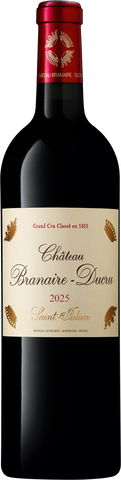
Saint-Julien · vintage 2006
Château Branaire-Ducru 2006
Ageing potential16-19 ans
 Grands crus atlas
Ageing potential16-19 ans
Content available in French
Vintage benchmark: 89/100 (appellation benchmark, not a score for this wine)
Vintage character: Rain at véraison followed by a dry September gave classic, balanced wines with fine freshness, without the density of 2005.
Overall reading of the year’s season across Saint-Julien. An estate can depart from it sharply, in frost or hail years, where two neighbours did not make the same vintage. What this particular wine actually gave is on its technical sheet and in the scores above.
Les cabernets et petit verdots sont colorés et riches, avec de beaux tanins et une belle pureté et complexité d’arômes. Ils sont encore plus beaux que les merlots. 2006 apparaît aujourd’hui comme un très beau millésime, avec une concentration globale du niveau des 2005, il figurera parmi les grandes réussites.
Content available in French
Shares for this vintage, as recorded on the 2006 technical sheet. The vineyard itself is planted with 70 % cabernet sauvignon, 22 % merlot, 4 % petit verdot, 4 % cabernet franc — a vintage blend departs from the area under vine as the year dictates.
Les cuves sont en acier inoxydable, thermorégulées de tailles différentes et adaptées au parcellaire. Le remplissage des cuves se fait par gravité. Ce fut la première installation gravitaire moderne à Bordeaux en1991. La température de fermentation est de 26-28 °C et la durée de macération de 3 semaines, adaptée à chaque qualité de vendange.
Content available in French
En barriques durant 16 à 20 mois, avec environ 60 à 65% de bois neuf
Content available in French
The Branaire-Ducru vineyard is made up of several separate parcels, but with a terroir that remains homogeneous, on a very fine gravel rise at Beychevelle. The soil consists mainly of Quaternary gravelly-siliceous alluvium lying on a bed of alios (iron hardpan). The average age of the vineyard is 35 years. The blend at Château Branaire-Ducru is 70% Cabernet Sauvignon, 22% Merlot and 4% each of Petit Verdot and Cabernet Franc. Planting density is 8,000 vines/ha, for a yield of 40 hl/ha. Harvesting is by hand, with rigorous sorting in the vineyard and on sorting tables. Viticulture is conventional.
Availability, allocations and terms: the Compagnie Médocaine will reply promptly. The estate and vintage are already filled in in the message.
The texts below copy in one click for your product sheets, catalogues and social channels. The printable sheet condenses the whole page onto a single A4 page.
For this vintage, the media library contains: packshots, labels. High-definition packshots, labels, back labels and lifestyle photos are reserved for clients and partners, on the Compagnie Médocaine’s VinCod media library.
Sheet checked on September 21, 2026. Technical data: the estate’s VinCod sheets. Critic scores: sources cited above, with their date. Vintage benchmarks and character: Compagnie Médocaine’s own editorial read. Soils and relief, where shown: the Compagnie Médocaine’s parcel survey and the Mapbox/IGN terrain model.