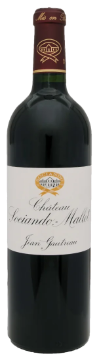
Haut-Médoc · vintage 2018
 Grands crus atlas
Vintage benchmark: 95/100 (appellation benchmark, not a score for this wine)
Vintage character: After a spring marked by mildew, the heat concentrated a small crop: rich, ripe wines with great depth of material.
Overall reading of the year’s season across Haut-Médoc. An estate can depart from it sharply, in frost or hail years, where two neighbours did not make the same vintage. What this particular wine actually gave is on its technical sheet and in the scores above.
Très puissant au niveau des arômes de fruits noirs, essentiellement dominés par des parfums balsamiques et de mûre sauvage, le nez affiche beaucoup d'éclat aromatique sans retenue. Tout se livre dans une fraîcheur sur des arômes purs et intenses. La bouche est puissante en milieu de bouche - sur des tanins présents mais très civilisés - milieu de bouche plein avec du poids qui s'achève en finale sur une trame tannique plus caressante. La puissance et la finesse conjuguées de ce Haut-Médoc est impressionnant de maîtrise et de précision. Un grand Sociando-Mallet.
Content available in French
Shares for this vintage, as recorded on the 2018 technical sheet. The vineyard itself is planted with cabernet sauvignon, merlot, cabernet franc — a vintage blend departs from the area under vine as the year dictates.
La vinification est faite de façon traditionnelle, et uniquement avec les levures et les bactéries indigènes, naturellement présentes sur le raisin de la propriété. Sociando-Mallet dispose de cuves inox et de cuves béton, toutes thermorégulées. Une fois mises en cuves, les baies de raisin éclatées vont fermenter sous l’action des levures. Les peaux et les pépins remontent à la surface, formant un chapeau de marc au dessus du moût (jus en fermentation). Ce marc contient toute la matière colorante et aromatique du raisin. Pour l’en extraire, on effectue des remontages quotidiens. Cela consiste à arroser le chapeau de marc à l’aide de moût que l’on soutire par le bas de la cuve.
Content available in French
En barriques 90% neuves, pendant 12 mois.
Content available in French
Since the 17th century, Sociando-Mallet has occupied the Baleyron knoll, one of the finest gravel terroirs in the Médoc. The terroir of Sociando-Mallet is made up of Günzian gravel over a deep clay-limestone subsoil. It allows the Cabernet Sauvignon to ripen in excellent conditions and the Merlot to acquire depth and complexity, while regulating the vine's water supply to perfection. This terroir is the soul of the Sociando wines, which owe to it their complex structure, their freshness and their elegance. The blend consists of 48% Cabernet Sauvignon, 47% Merlot and 5% Cabernet Franc. The vines are 30 years old on average.
Availability, allocations and terms: the Compagnie Médocaine will reply promptly. The estate and vintage are already filled in in the message.
The texts below copy in one click for your product sheets, catalogues and social channels. The printable sheet condenses the whole page onto a single A4 page.
For this vintage, the media library contains: labels. High-definition packshots, labels, back labels and lifestyle photos are reserved for clients and partners, on the Compagnie Médocaine’s VinCod media library.
Sheet checked on September 21, 2026. Technical data: the estate’s VinCod sheets. Critic scores: sources cited above, with their date. Vintage benchmarks and character: Compagnie Médocaine’s own editorial read. Soils and relief, where shown: the Compagnie Médocaine’s parcel survey and the Mapbox/IGN terrain model.