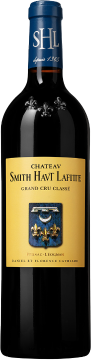
Pessac-Léognan · vintage 2014
Château Smith Haut-Lafitte 2014
Ageing potential20 years and more
 Grands crus atlas
Ageing potential20 years and more
Vintage benchmark: 90/100 (appellation benchmark, not a score for this wine)
Vintage character: A gloomy summer redeemed by an Indian summer: the cabernets are radiant and the freshness is true to the Médoc.
Overall reading of the year’s season across Pessac-Léognan. An estate can depart from it sharply, in frost or hail years, where two neighbours did not make the same vintage. What this particular wine actually gave is on its technical sheet and in the scores above.
The wine is red, very dark. The first nose is expressive, very dark fruit, wild blackberry, blackcurrant, then on swirling it opens up fully and offers a power in which black fruit, red fruit, spice, pepper, liquorice and delicate flint notes mingle... The palate is taut and round, thanks to great acidity balanced by lovely concentration and good tannic structure. The wine is structured, concentrated, all tension and energy. The aromatics on the palate are very close to those of the nose, with cherry, blackcurrant, wild blackberry, liquorice, cinnamon and great gunflint minerality.
Shares for this vintage, as recorded on the 2014 technical sheet. The vineyard itself is planted with 30 % merlot, 60 % cabernet sauvignon, 9 % cabernet franc, 1 % petit verdot — a vintage blend departs from the area under vine as the year dictates.
During tank filling, the grapes are chilled, encouraging a pre-fermentation maceration in an aqueous phase favourable to the exchange of colour and aroma. Fermentations then begin naturally with the indigenous yeasts of the cellar.
18 months in barrels (60% new barrels made in our own in-house cooperage), ageing on lees, a single racking, then ageing adjusted for each wine.
The terroir has such a strong personality that it gave the region its name: "Les Graves". These graves are an accumulation of alluvial, sandy and stony deposits laid down on a Tertiary limestone subsoil by the turbulent rivers and glaciers of the early Quaternary era, subsequently reshaped into gravel rises by erosion. At Smith Haut Lafitte, the soil is made up of one of the rare Günzian gravel rises, thick and ochre in colour, a sign of its richness in iron oxide. This soil is of high quality for viticulture because it is at once free-draining, very poor and warm at the surface, while maintaining a degree of coolness and moisture at depth (clay or limestone).
Availability, allocations and terms: the Compagnie Médocaine will reply promptly. The estate and vintage are already filled in in the message.
The texts below copy in one click for your product sheets, catalogues and social channels. The printable sheet condenses the whole page onto a single A4 page.
For this vintage, the media library contains: labels. High-definition packshots, labels, back labels and lifestyle photos are reserved for clients and partners, on the Compagnie Médocaine’s VinCod media library.
Sheet checked on September 21, 2026. Technical data: the estate’s VinCod sheets. Critic scores: sources cited above, with their date. Vintage benchmarks and character: Compagnie Médocaine’s own editorial read. Soils and relief, where shown: the Compagnie Médocaine’s parcel survey and the Mapbox/IGN terrain model.