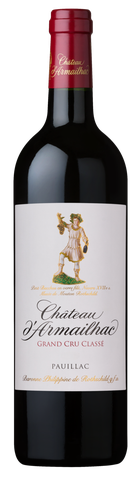
Pauillac · vintage 2024
 Grands crus atlas
Vintage benchmark: 87/100 (appellation benchmark, not a score for this wine)
Vintage character: A rainy spring and a difficult flowering reduced the crop; the dry October saved fine, light, easy-drinking wines.
Overall reading of the year’s season across Pauillac. An estate can depart from it sharply, in frost or hail years, where two neighbours did not make the same vintage. What this particular wine actually gave is on its technical sheet and in the scores above.
Ruby red with purple highlights, the wine reveals a beautiful aromatic intensity, dominated by notes of blueberry and raspberry, accompanied by subtle aromas of blackcurrant bud and a touch of peppermint. The overall impression is harmonious, underlined by the freshness, the red fruits intertwining with a delicate floral imprint. Toned, straight and slender, it offers vitality on the palate, before deploying an elegant texture with a suave texture, while maintaining a silky sensation. Its great finesse and precision, accompanied by a salty touch, linger in elegance and purity.
Shares for this vintage, as recorded on the 2024 technical sheet. The vineyard itself is planted with cabernet sauvignon, merlot, cabernet franc, petit verdot — a vintage blend departs from the area under vine as the year dictates.
In stainless steel tanks for 15 to 20 days
18 months in oak barrels (50% new)
Château d'Armailhac lies in the northern part of the commune of Pauillac. It has 69 hectares of vines. Château d'Armailhac is made up of three groups of parcels: the Levantines and Obélisque plateau (26 hectares), an extension of the celebrated Carruades plateau of Mouton, made up of light and very deep gravel, the terroir of choice for the Cabernets; the Pibran plateau (19 hectares), whose gravel rests on a partly clay-limestone subsoil, hence the finesse and elegance characteristic of the wines of Château d'Armailhac; and the Béhéré gravel rise (5 hectares), of light gravel which can nonetheless run down to 3 metres deep.
Availability, allocations and terms: the Compagnie Médocaine will reply promptly. The estate and vintage are already filled in in the message.
The texts below copy in one click for your product sheets, catalogues and social channels. The printable sheet condenses the whole page onto a single A4 page.
For this vintage, the media library contains: labels, back labels. High-definition packshots, labels, back labels and lifestyle photos are reserved for clients and partners, on the Compagnie Médocaine’s VinCod media library.
Sheet checked on September 21, 2026. Technical data: the estate’s VinCod sheets. Critic scores: sources cited above, with their date. Vintage benchmarks and character: Compagnie Médocaine’s own editorial read. Soils and relief, where shown: the Compagnie Médocaine’s parcel survey and the Mapbox/IGN terrain model.